Dollarization Explained: Why Countries Use Foreign Currency
Dollarization means a country's people use a foreign currency, usually the US dollar, for everyday money. A plain look at why it happens, how full and partial versions differ and what it means for exchange-rate risk.

Buying a coffee in Quito and getting billed in US dollars is not a courtesy extended to tourists. In 2000, Ecuador switched from the sucre to the dollar. Why on earth would a country do that? Why should a currency trader care?
What Is Dollarization and How Does It Work?
Under dollarization a foreign currency, usually the US dollar, is used by a country’s population for money transactions (i.e. for paying, saving, shopping, borrowing etc.). The country’s own currency may still be used, or it may be used very little and only for change, taxes etc.
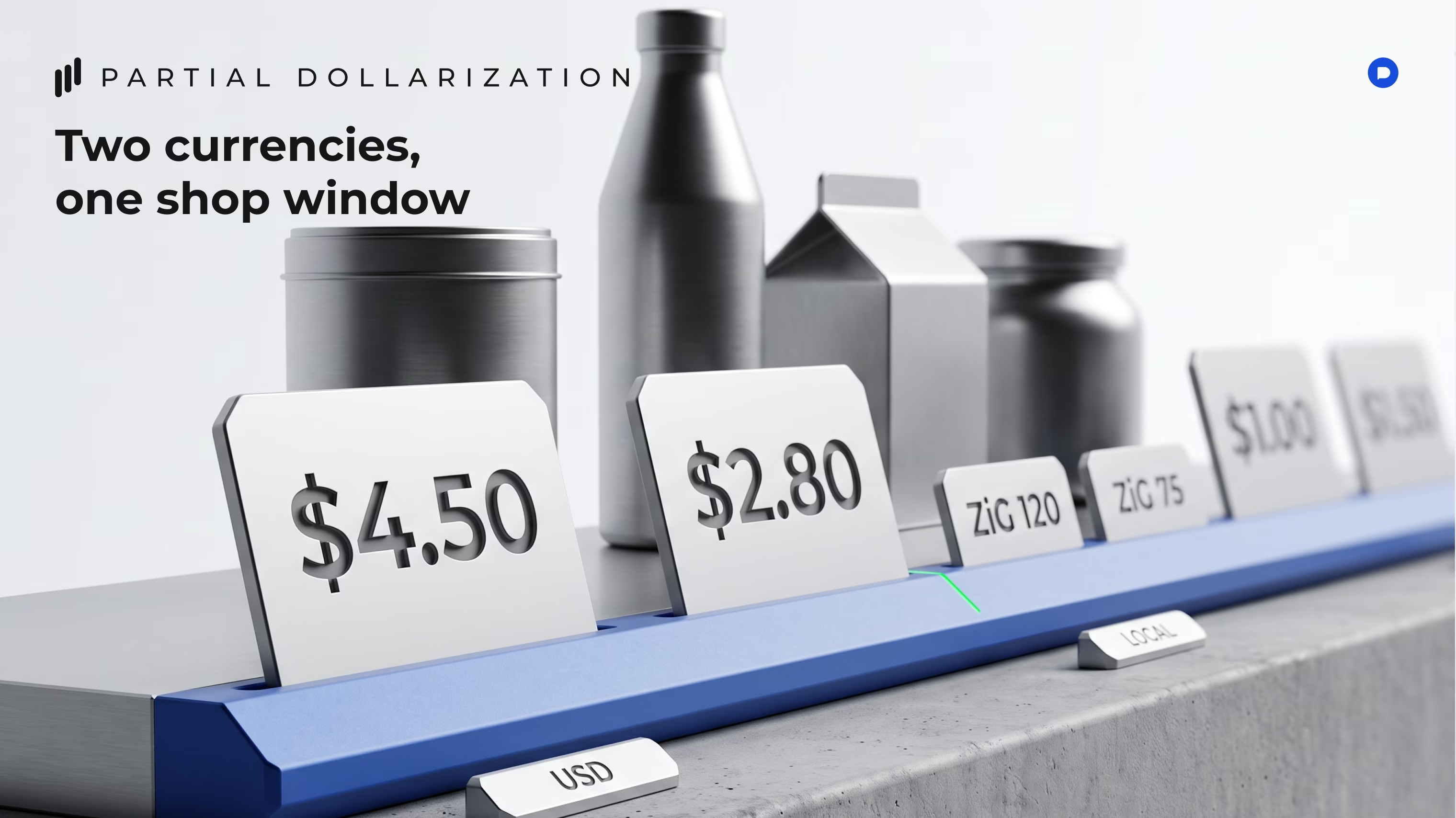
Real life is messier than an official switch. Shops publish prices in foreign currency first, landlords demand rent in foreign currency, savers keep their money in foreign currency deposits.
Sometimes countries officially make a foreign currency legal tender, while other times they don’t do anything and people start using it anyway. Both scenarios count.
Market action helps to better understand a currency under pressure than do stories. Before forming any view on dollarization, live currency markets need to be watched, especially when a currency is under severe pressure.
Create a Pocket Broker account and follow real currency pairs before making any trading decision.
Create AccountIf you read about one of the world’s currencies being in trouble, select that currency and follow a major pair containing it for several days. First, open up a one-year chart of that pair, followed by a one-day chart. Much of the daily activity is noise, and no single chart explains dollarization by itself.
Ready to try it? You can create a Pocket Broker account and open the pairs yourself.
Why Do Countries Turn to Foreign Currencies?
When a currency fails at its principal function, holding value, people stop trusting it. Want to watch a weak currency slide against a stronger one? You can try Pocket Broker demo, with virtual funds.
One major reason for a loss of confidence in a country’s local currency is high inflation. A falling exchange rate is also often a big factor, as importers, landlords and employers start to quote in dollars to protect themselves against future falls. And once a banking crisis or even political uncertainty has created mistrust of a country’s local currency then it can all collapse very quickly, as happened in Zimbabwe in the 2000s for example. That is what is dollarization in practice: people dropped the local notes long before the government did.
Full vs Partial Dollarization: What's the Difference?
Full: the foreign currency has been made legal tender by the country’s government. Ecuador went this way in 2000, after a severe banking crisis and the collapse of its local currency. Partial: the foreign currency and the local currency are used simultaneously by a country, usually without any law behind it. That is the dollarization meaning in both its forms.
Both versions are affected by fluctuations in the exchange rate of the dollar on the currency markets, and this affects all payments made and received in dollars. That's a story about forex volatility, and it does not stop at the border.
Side by side:
Criterion | Full Dollarization | Partial Dollarization |
|---|---|---|
National currency | Largely replaced, often no longer issued | Still in use next to the foreign currency |
Status of foreign currency | Official legal tender | Often informal, accepted in practice |
Role of central bank | Limited to oversight and reserves | Keeps its tools with reduced reach |
Exchange-rate risk | Gone against the adopted currency, present against others | Still present, shared between two currencies |
A currency peg is different. A peg keeps the local money alive at a fixed rate. Adopting the dollar swaps the money itself.
What Happens to Monetary Policy After Dollarization?
By a country abandoning its local currency and adopting the dollar as official currency, it hands over the “print” to someone else. It will not be able to set interest rates, nor will it be able to create local currency to pay for its budget deficits. Nor can it let its currency depreciate to stimulate exporters. Instead, local interest rates will move in tandem with those of the US Federal Reserve.
The partial model still includes a central bank issuing money and setting interest rates. However, given the growing number of wallets holding dollars rather than the local currency, the central bank’s impact is limited.
Does Dollarization Remove Exchange-Rate Risk?
Partly true. The risk against the adopted currency disappears, and a shop owner in Quito no longer loses sleep over the sucre. But new risks appear in the form of fluctuation of the adopted currency against other main currencies (euro, yen, trading partners’ currencies) and even more so as a result of interest rate decisions by the Federal Reserve. Less of one risk, more of a different risk.
What Should Forex Traders Watch in a Dollarized Economy?
An economy that runs on the dollar is not a trading idea. Rather, it is background to the currencies being followed on Pocket Broker. Some items to monitor would be:
Inflation trends
Exchange-rate regime
Federal Reserve decisions
Foreign currency reserves
External indicators
Such information will not necessarily translate into trade ideas; it indicates the type of pressure being exerted.
Risk Disclaimer: Trading involves significant risk of capital loss. This article is for educational purposes only and does not constitute financial advice. Always conduct independent research and consider your risk tolerance before making any trading decisions.
See more:Forex & Markets