How to Calculate Net Debt and Interpret the Result
Net debt shows what a company owes after counting its cash. This guide covers the formula, what counts as debt and cash, how it differs from gross debt and how to read changes in financial reports.

A company that owes the bank 500 million sounds like trouble. Then you notice it also keeps 450 million in cash, and the worry shrinks. Analysts don't stop at the size of a debt pile for exactly this reason. They look at what's left once cash is set against it, and one number does that job in nearly every earnings release.
What Is Net Debt?
My shortest definition: net debt is what remains of the debt after cash has had its say. On paper, that's total debt minus cash and cash equivalents. What counts as debt or cash varies by company, so I read the footnote before I trust any figure.
Why subtract at all? Because cash on hand could repay part of the loan tomorrow. The headline debt ignores that. The adjusted figure doesn't.
Create an account and open the price chart of a company whose balance sheet you are reading.
Go to Pocket BrokeNet debt stops being abstract once you watch a real company's balance sheet next to its price chart.
Try this once, it takes about ten minutes. Open the latest report of a company you follow and find three lines on the balance sheet: loans and bonds, other borrowings, cash. Add the first two, subtract the third, write the answer down. Repeat for the previous quarter. Do that a couple of times and net debt stops being jargon.
To keep a few of those price charts open while you read the reports, create a Pocket Broker account.
How to Calculate Net Debt
Reports land, charts react. To see that for yourself without risking real money, try Pocket Broker demo.
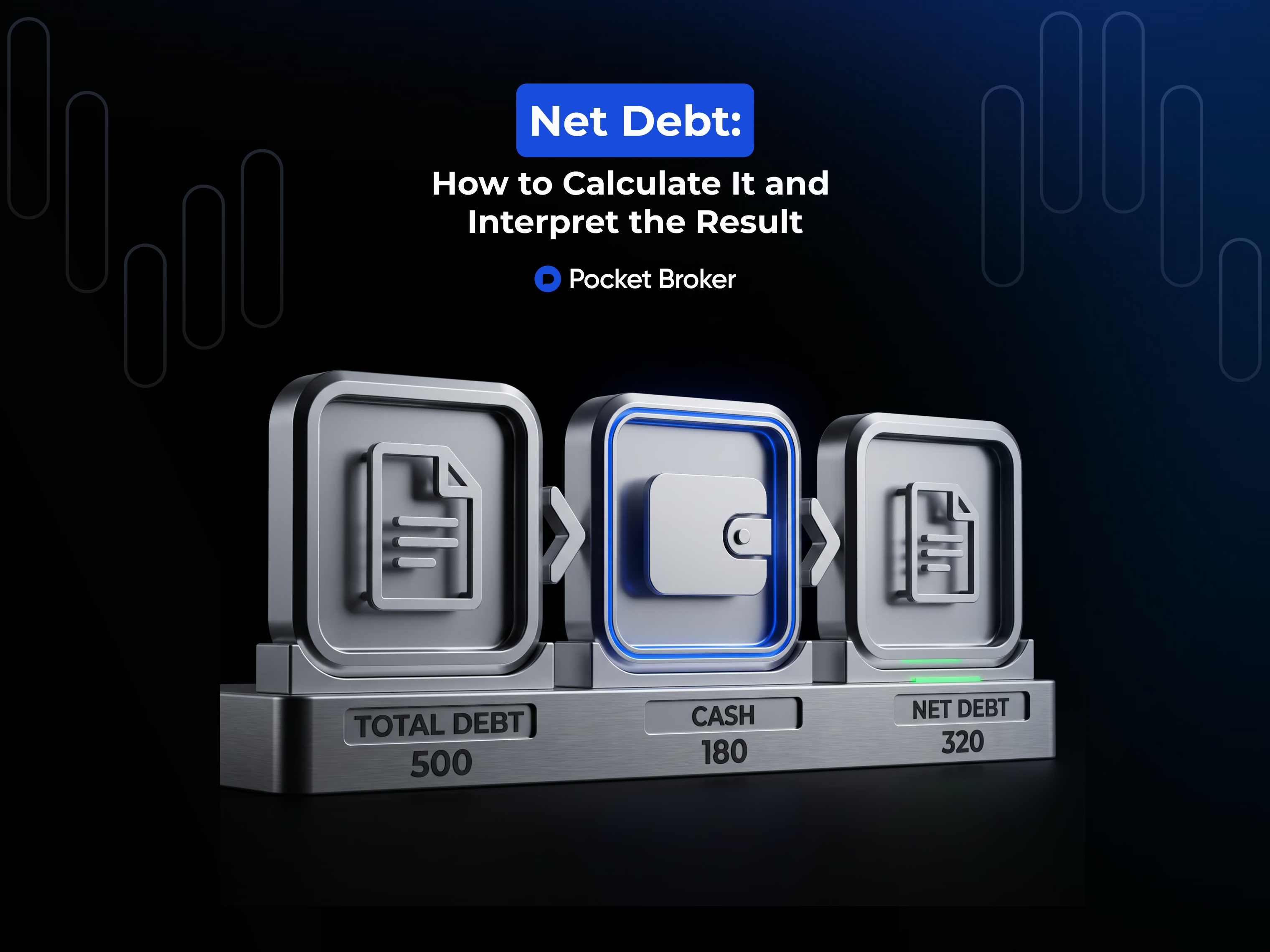
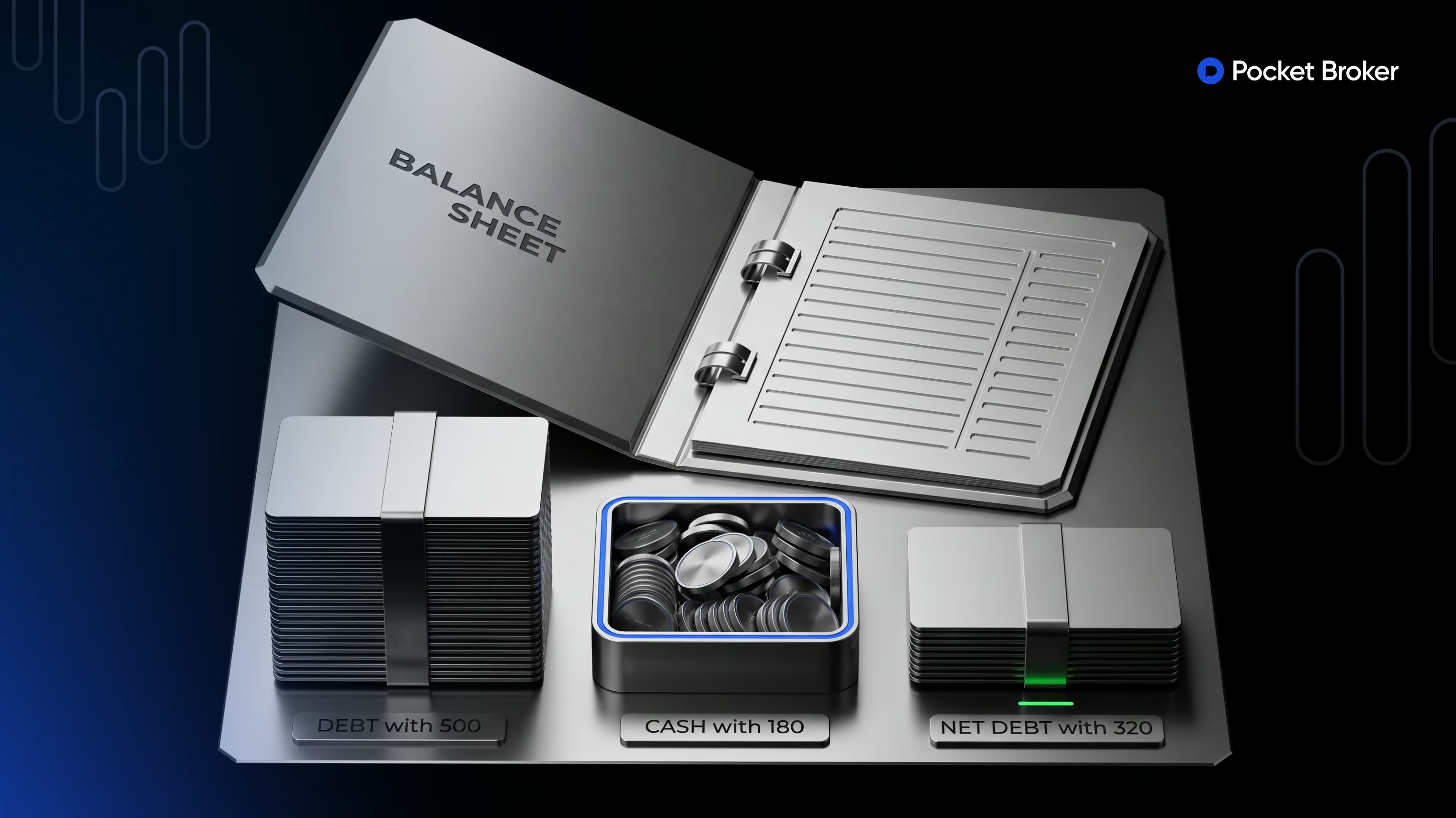
The net debt formula fits on a napkin: total debt minus cash and cash equivalents. Add up the debt, add up the cash, subtract. A company owing 500 with 180 in cash is left with 320. One owing 300 with 100 in cash is left with 200. Same arithmetic, very different cushions. And I always check the units, because reports slide between thousands and millions without warning.
What Counts as Debt and Cash?
Which obligations count as debt? Usually bank loans, bonds, notes and, often, lease obligations. Which cash? Bank balances, cash on hand, short-term deposits and very liquid instruments. Then there's the gray zone: restricted cash, money held abroad, pension deficits. Some companies include those items, some leave them out. So what is net debt in a given report? Whatever that company's own definition says, and the definition lives in the notes.
Net Debt vs Gross Debt
Gross debt counts every obligation whole; the adjusted figure subtracts what the company holds. Knowing how to calculate net debt takes a minute. Putting the two numbers side by side is where the thinking starts.
Factor | Gross Debt | Net Debt |
|---|---|---|
Calculation | Sum of all reported debt | Total debt minus cash and cash equivalents |
Cash | Ignored | Subtracted |
Shows | Size of the obligations | Obligations left after cash |
Blind spot | Cash that could repay debt | Quality and timing of that cash |
Same company, two numbers: with 500 of debt and 180 of cash, gross debt is 500 and the adjusted figure is 320. The gap between the two columns is the cash.
What Does Negative Net Debt Mean?
What if cash is bigger than debt? Say a company owes 200 and holds 260. The net debt calculation lands at minus 60, which means it holds 60 more than it owes. Safe? I wouldn't say so on that basis alone. Some of that cash may be earmarked, some may sit abroad, some may leave next quarter, and the figure can't see next year's orders.
Why Net Debt Matters in Company Analysis
Interest is due whether sales are strong or weak, so debt decides how much slack a company has in a slow season. The adjusted figure shows that burden with the cushion included, which tells you more than the headline. When it shifts, markets notice, and so do lenders. Noticing isn't direction, though: the number doesn't say where a share price goes next. Big debt with thin cash worries lenders. Big debt with deep cash worries them far less.
How Net Debt Relates to EBITDA
Divide the figure by a year of EBITDA and you get a net leverage ratio: roughly how many years of operating earnings the leftover debt would take to cover. With 320 left against 200 of EBITDA, that's about one and a half years. With 50 left, a quarter of a year. Smaller means lighter. I skip thresholds, since what counts as high differs by industry, and EBITDA still isn't cash flow.
What Can Cause Net Debt to Change?
Six things can move the number:
Borrowing or debt repayment: new loans raise debt, repayments lower it
Changes in cash balances: more cash lowers the result, less cash raises it
Operating cash generation: cash from the business builds the cushion
Acquisitions: purchases use cash or add debt, often both
Capital expenditure: spending on equipment and buildings drains cash
Dividend payments: cash paid to owners leaves the company
Say a company pays 80 in cash for new equipment. Debt hasn't moved, cash has dropped, so the adjusted figure rises by 80 though nobody borrowed a cent. A rise isn't automatically bad and a fall isn't automatically good. The reason behind the move is the story.
How to Interpret Net Debt in Financial Reports
My last rule: no number gets read alone. Put the result beside cash flow, EBITDA, the repayment schedule and the company's own notes, then ask three things. When is the debt due? How steady is the cash? What does the definition cover? A big loan due next spring is a different animal from the same loan due in ten years. Judge the business on the whole report, not on one line.
Risk Disclaimer: Trading involves significant risk of capital loss. This article is for educational purposes only and does not constitute financial advice. Always conduct independent research and consider your risk tolerance before making any trading decisions.
See more:Shares Trading