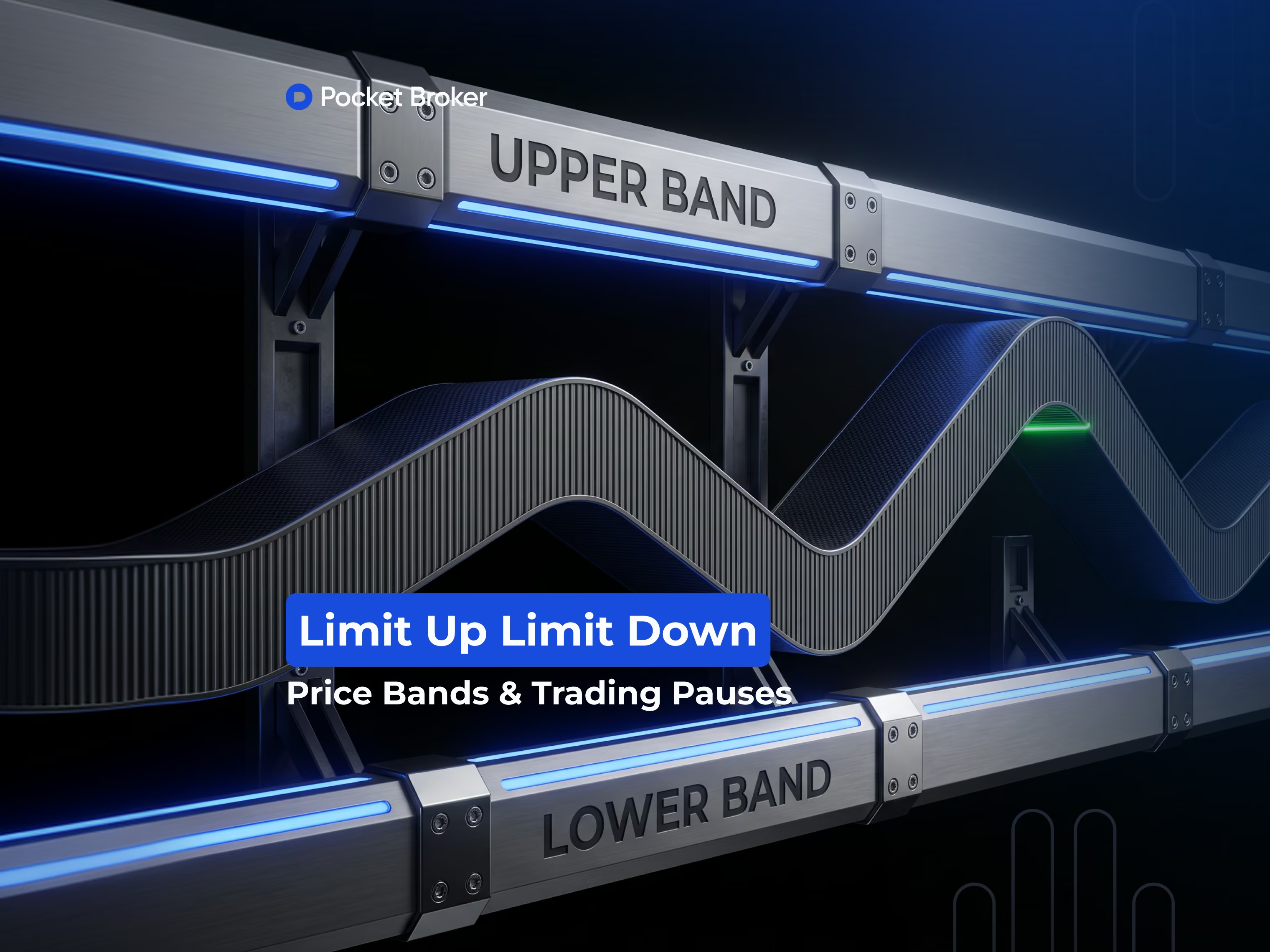
Limit Up Limit Down (LULD): How Stock Price Bands Work
Limit up limit down is a US stock market rule that draws a moving price corridor around a stock. This guide explains how LULD price bands work, when a trading pause can start and how the rule differs from market-wide circuit breakers.

Picture a $20 stock and a thin order book. One oversized sell order sweeps through the quotes and the price prints $14 for half a second before bouncing back. Stop orders fire. Some people get filled at a price that existed for a blink. That's the problem price bands exist to soften. When prices move too far, too fast, the market needs a guardrail.
What Is Limit Up Limit Down (LULD)?
Limit up limit down, or LULD for short, is a US stock market rule that draws a moving corridor around a stock's recent price. Trades aren't supposed to happen outside the corridor, and if a stock stays pinned at its edge, trading can pause for a few minutes.
Read that carefully. The bands limit where trades can happen, not whether the price can move. A stock can climb or fall all day as long as its trades stay inside a moving corridor. Limit up limit down is a guardrail, not a freeze, and it's a market-wide rule set, not a feature of any one broker.
Create an account and follow a fast-moving stock on a live chart.
Go to Pocket BrokerLimit up limit down makes more sense on a live chart than in a rulebook.
Watch a fast-moving stock on a busy news day and you see what limit up limit down is protecting against. Prices race, quotes thin out, spreads widen. A rulebook describes that in paragraphs. A chart shows it in seconds, and after a few sessions limit up limit down stops sounding abstract.
The Pocket Broker quick start guide shows how to set up a chart and follow a stock through a volatile session.
How LULD Price Bands Work
Want to see bands in action? You can create a Pocket Broker account and follow a stock through a volatile session.
The limit up limit down rule starts from a reference price: roughly the average trade price over the last five minutes. Around it sit two lines, an upper band above and a lower band below, each a set percentage away. That percentage depends on the stock's tier and price level, and it can be wider at certain times of day.
That's the heart of the limit up limit down rule. Trades are expected to happen inside the corridor, and prices outside it don't get executed. The corridor isn't fixed, though. As the market moves, the reference price updates and the bands shift with it.

What Happens When a Stock Reaches a Price Band?
On a limit up limit down price bands chart, the stock's price wanders between two moving lines. Most of the time it never gets near them. When it does, the stock enters what the rules call a limit state: quotes sit right at the edge of a band. Trading can still go on inside the corridor.
So when does a pause happen? If the stock is still stuck at the edge after about 15 seconds, the primary listing exchange pauses it for five minutes and reopens trading with an auction. Touching a band alone doesn't do that. Plenty of touches clear within seconds.
LULD vs Market-Wide Circuit Breakers
Now the part people mix up. LULD protects individual stocks and ETFs. Market-wide circuit breakers watch the whole market. One is a guardrail on a single road, the other a traffic stop for the entire city. Here's the comparison.
Factor | LULD | Market-Wide Circuit Breakers |
|---|---|---|
Scope | One stock or ETF at a time | The broad US market |
Trigger | A price stuck at the edge of its dynamic band | A large decline in a broad market index |
Affected instruments | The individual security that reached its band | Stocks across the market |
Possible result | A short pause in that security, then a reopening | A market-wide halt, from a short pause to the rest of the day |
A stock can pause under LULD while the rest of the market trades normally. That happens regularly on single-name news. And futures have price limits with a similar name. That's a separate system.
Why LULD Uses Dynamic Price Bands
Why not draw one line for the whole day? Because the right line moves. Imagine a guardrail bolted down at 9:30. A stock that gaps on earnings would slam into it on the first trade and stay there. Bands that re-center on recent prices let a stock settle at a new level step by step, while still blocking prints far from the action.
That ties straight into volatility. When a stock is moving fast, the corridor follows it. When it calms down, the corridor settles too.
What Can Trigger an LULD Trading Pause?
The rules don't care why a price moves. They care where it sits relative to the bands. Still, a few situations make a band touch more likely:
Sharp volatility: prices lurching up and down in short bursts
A news-driven move: earnings, a headline, a rumor
A rapid shift in supply and demand: a rush of buyers or sellers at once
Low liquidity: few resting orders, so a single trade moves the price a lot
Keep two things apart. The reason a stock moved and the formal trigger for a pause aren't the same. News can push a price to a band. The pause comes from the stock staying there, not from the headline.
How LULD Can Affect Trading and Price Discovery
Bands and pauses briefly limit where trades can happen, which buys the market a moment: a headline gets read, new quotes show up, traders reprice. Call it a breather, not a verdict.
What comes after? A price might settle. It might keep going. It might snap back. Nothing in the mechanism promises any of those.
How to Read an LULD Event Correctly
Read an LULD event like any sudden move: next to the news, the volume, the liquidity and what the wider market is doing. A pause isn't a sign something is wrong with the company. It isn't a buy or sell signal either. It's the market slowing down for a moment.
And remember what the mechanism can't do. It can't remove sharp moves, or the risk that comes with them.
Risk Disclaimer: Trading involves significant risk of capital loss. This article is for educational purposes only and does not constitute financial advice. Always conduct independent research and consider your risk tolerance before making any trading decisions.
See more:Shares Trading