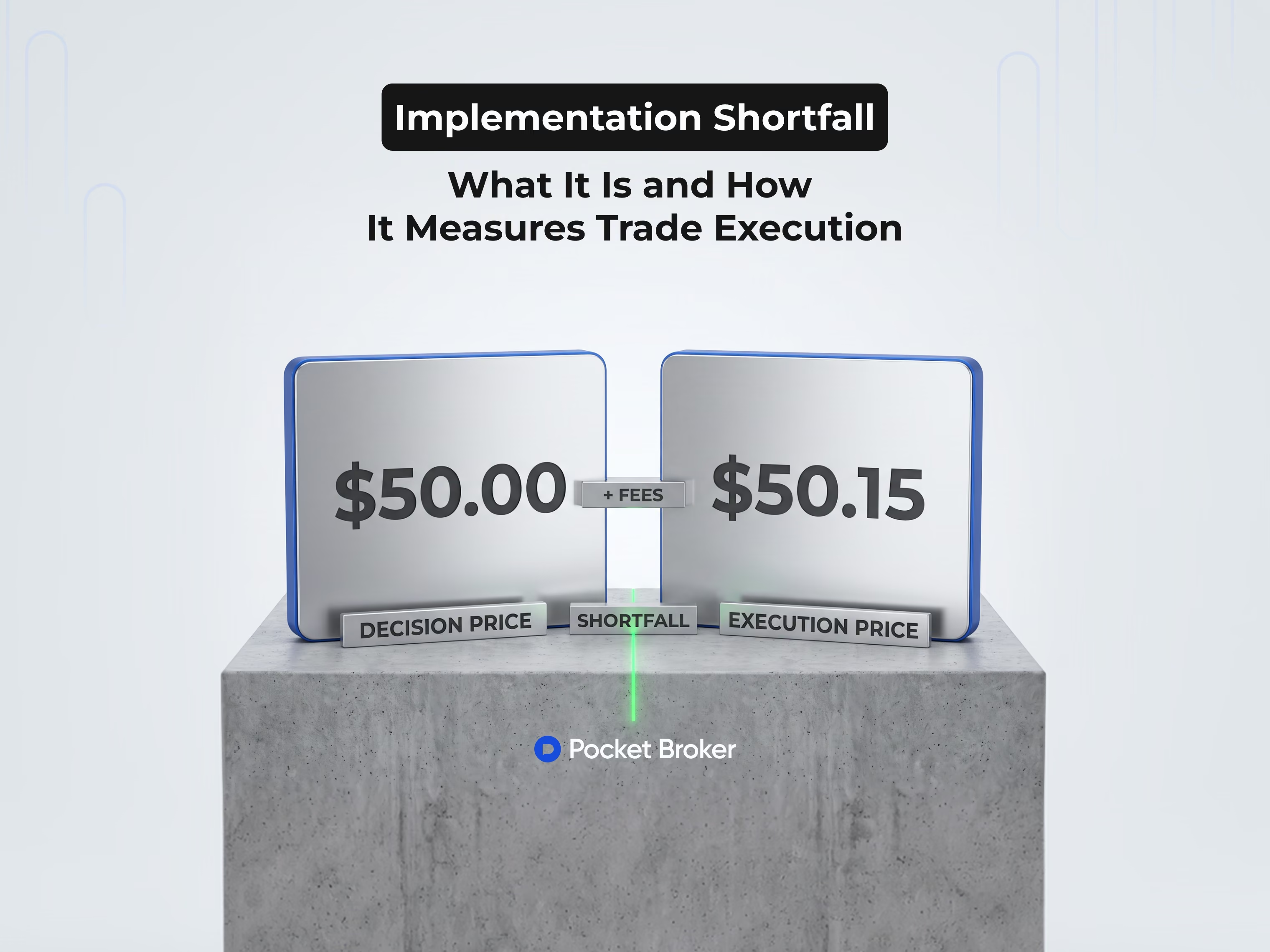
Implementation Shortfall: What It Is and How It Measures Trade Execution
Implementation shortfall measures the gap between the price you decided at and what a trade actually cost. This guide covers the formula, a simple example, the components of the gap and how it differs from slippage.

You see a stock at $50.00, click buy, and the fill comes back at $50.15. Fifteen cents. Who took it? Sometimes the market moved while you were still thinking. Sometimes your own order nudged the price. Sometimes it's just fees. The number on your screen and the number in your account rarely agree to the cent.
What Is Implementation Shortfall?
Implementation shortfall measures the gap between what a trade would have cost at the price you had in mind when you decided, and what it actually cost once it was done.
It isn't only about price. Part of the gap is the market moving while you waited. Part is the order's own footprint. Part is fees and spreads. Implementation shortfall adds all of that up, which is why it's broader than one price difference.
Create an account and compare the price you see with the price you get.
Go to Pocket BrokerExecutions look simple until you check them against the price you started with.
Try a tiny experiment. On your next trade, jot down the price on screen the second you click. Then check the average fill. A decision price, an execution price and whatever sits between them: that's implementation shortfall made concrete. Do it for ten trades and you'll see how often implementation shortfall is pocket change, and how often it isn't.
When you want to try it, create a Pocket Broker account and log the price you see against the price you get.
How Implementation Shortfall Works in a Trade
Want to practice spotting the gap? You can try Pocket Broker demo and compare screen prices with fills using virtual funds.
Say a stock is quoted around $50 and you decide to buy. That quote is your benchmark. Then life happens: a few seconds of hesitation, a slow click, a busy market. The order goes out and the quote isn't where it was. The fill lands higher. Fees go on top, and the final cost has drifted away from the number you started with.
That's the definition of implementation shortfall in trading, minus the jargon: how far the real, all-in result sits from where you started.
Implementation Shortfall Formula and Example
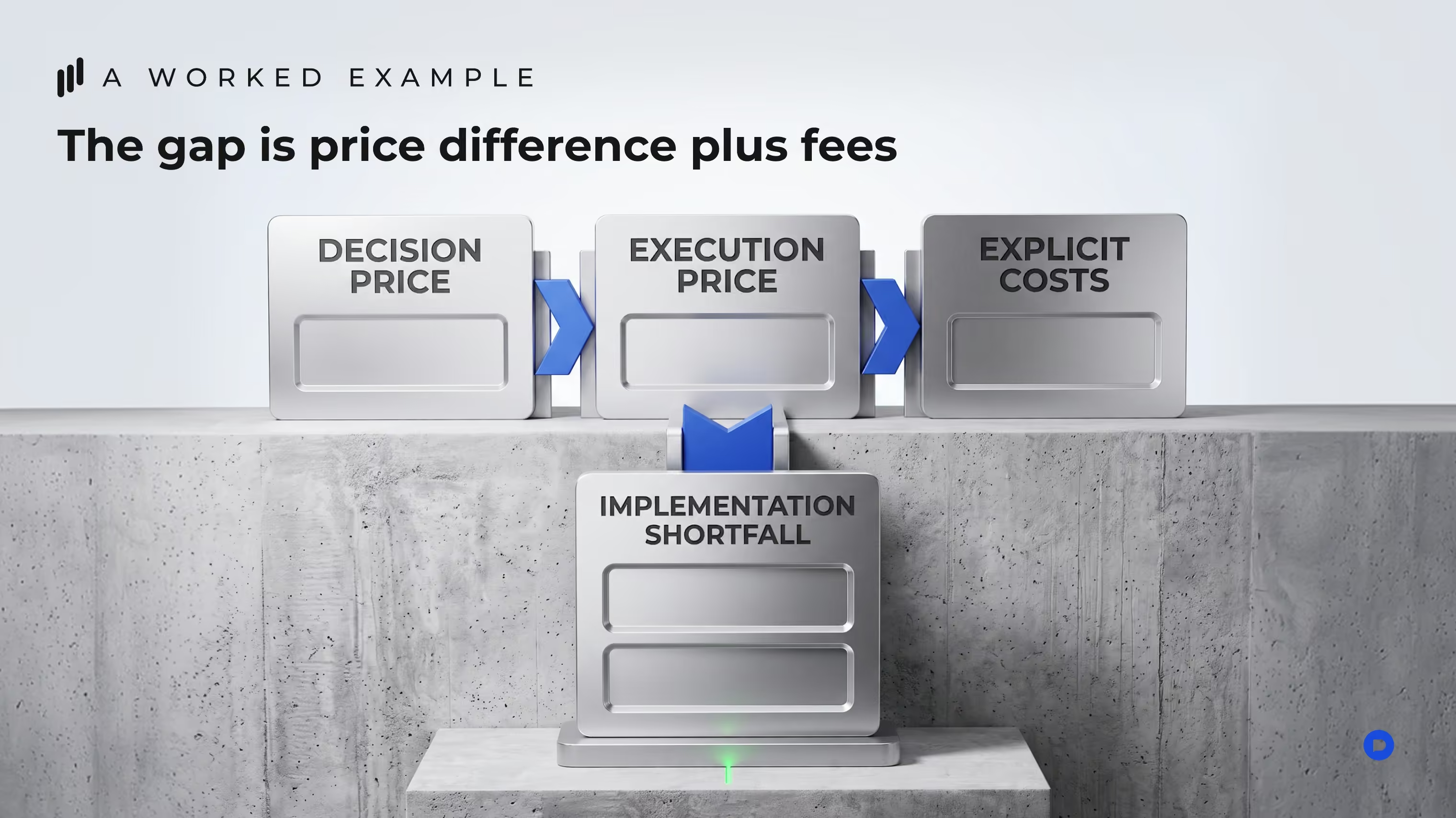
The implementation shortfall formula for a buy order is short: (execution price - decision price) × shares + explicit costs. For a sell, the price part flips. The decision price is the quote when you made the call. The execution price is what you actually paid on average. Explicit costs are commissions and fees.
Take round numbers. You decide to buy 1,000 shares at $50.00. They fill at $50.15 on average, and fees come to $15. The price gap is 15 cents a share, so $150 across 1,000 shares. Add the $15 and you land at $165. Spread over the $50,000 you meant to spend, that's 0.33%.
Now run the implementation shortfall formula on a trade filled at exactly $50.00 with the same $15 in fees. The answer is $15. Everything above that in the first example came from price.
What Makes Up Implementation Shortfall?
In any implementation shortfall definition trading guides give, the total splits into four parts. The table shows them.
Component | What It Means | How It Can Affect Execution |
|---|---|---|
Delay cost | Price drift between decision and order | Can add cost or save it, depending on direction |
Price movement | Moves while the order is being filled | Matters more in fast markets |
Market impact | The order's own effect on the price | Grows with size versus liquidity |
Explicit execution costs | Commissions and fees | Visible, but they add to the total |
The mix changes from trade to trade. Small order, calm market? Mostly fees. Big order, thin market? Mostly impact.
Why Decision Price and Execution Price Can Differ
Set the implementation shortfall definition aside and ask something simpler: why do the two prices differ at all? Quotes move between decision and execution. Liquidity can be thin right at your price, so the order eats through several levels of the book. The spread means you buy at the ask, not the midpoint. A bigger order takes more of what's on offer. And delay gives all of it more time to happen.
A difference isn't automatically bad execution. Sometimes the market simply moved.
Implementation Shortfall vs Slippage
So what is implementation shortfall in trading compared with slippage? Slippage is a slice. The shortfall is the pie.
Slippage looks at the price you expected when you hit send versus the price you got. The shortfall starts earlier, at the moment you decided, and counts everything after: delay, movement, impact, fees. You can see tiny slippage and a fat shortfall in the same trade if the market ran off before your order even left.
What Can Increase Implementation Shortfall?
Several things push the number up. These are the usual ones:
High volatility: prices move more between the decision and the fill
Low liquidity: fewer shares at each price, so the fill spreads across worse levels
Wide spread: the gap between buy and sell prices is paid on entry
Execution delay: more time for the market to drift away from the benchmark
Large size relative to available liquidity: a big order uses up more of what's on offer
Market impact: the order's own pressure on the price
None of these is a mistake. They're conditions.
How to Interpret Implementation Shortfall Carefully
A high shortfall doesn't prove bad execution. Maybe the stock gapped on news right after you decided. Maybe the book was thin. Maybe the order was simply big. Read the number next to market movement, liquidity, timing and size.
Use it to look at an execution in context, not to hand out a grade. It's a tool for asking questions, not a universal ranking of trades.
Risk Disclaimer: Trading involves significant risk of capital loss. This article is for educational purposes only and does not constitute financial advice. Always conduct independent research and consider your risk tolerance before making any trading decisions.
شاهد المزيد:Shares Trading