Marking the Close: What It Is and Why It Is Market Manipulation
Marking the close is an attempt to move the closing price right before the session ends. This guide explains why the closing price matters, how it differs from legitimate trading at the close and why regulators treat it as market manipulation.

The last ten minutes before the bell feel a bit like the checkout line before a shop closes. Funds rebalance. Traders flatten positions. Orders stack up. Nearly all of it is ordinary. But one number comes out of that rush and gets copied into charts, reports and daily returns: the closing price. So when something looks odd right before the bell, regulators pay attention.
What Is Marking the Close?
Marking the close is an attempt to push a security's price around right before the session ends, so the recorded closing price says something the market doesn't really believe.
Notice the word attempt. Trading in the last minutes isn't marking the close. Plenty of honest orders land late in the session, and plenty of honest prices move. What turns activity into marking the close is intent: the aim of moving the closing price itself.
Create an account and watch how prices behave in the final minutes of a trading session
Go to Pocket BrokeTextbook definitions stay abstract until you watch a session end.
Try this: pick a stock, open a live chart and stay for the last ten minutes of the session. Volume builds, spreads wobble, prices drift. That's ordinary closing behavior, and once you've seen it a few times, marking the close stands out far more easily, for you and for regulators. Reading about it only goes so far.
The Pocket Broker quick start guide shows how to set up a chart and follow a stock through a full session.
Why the Closing Price Matters
Want to try it? You can create a Pocket Broker account and open a chart before the bell.
So what is marking the close really after? One number. The closing price is the last recorded price of the session, and it travels. Charts use it. Daily gain or loss is measured against it. Reports, fund valuations and some benchmark calculations lean on it too.
That reach is the point. Move the closing price and you're not just changing one trade. You're changing a figure other people use as a reference for the whole day.
How Marking the Close Can Distort Market Prices
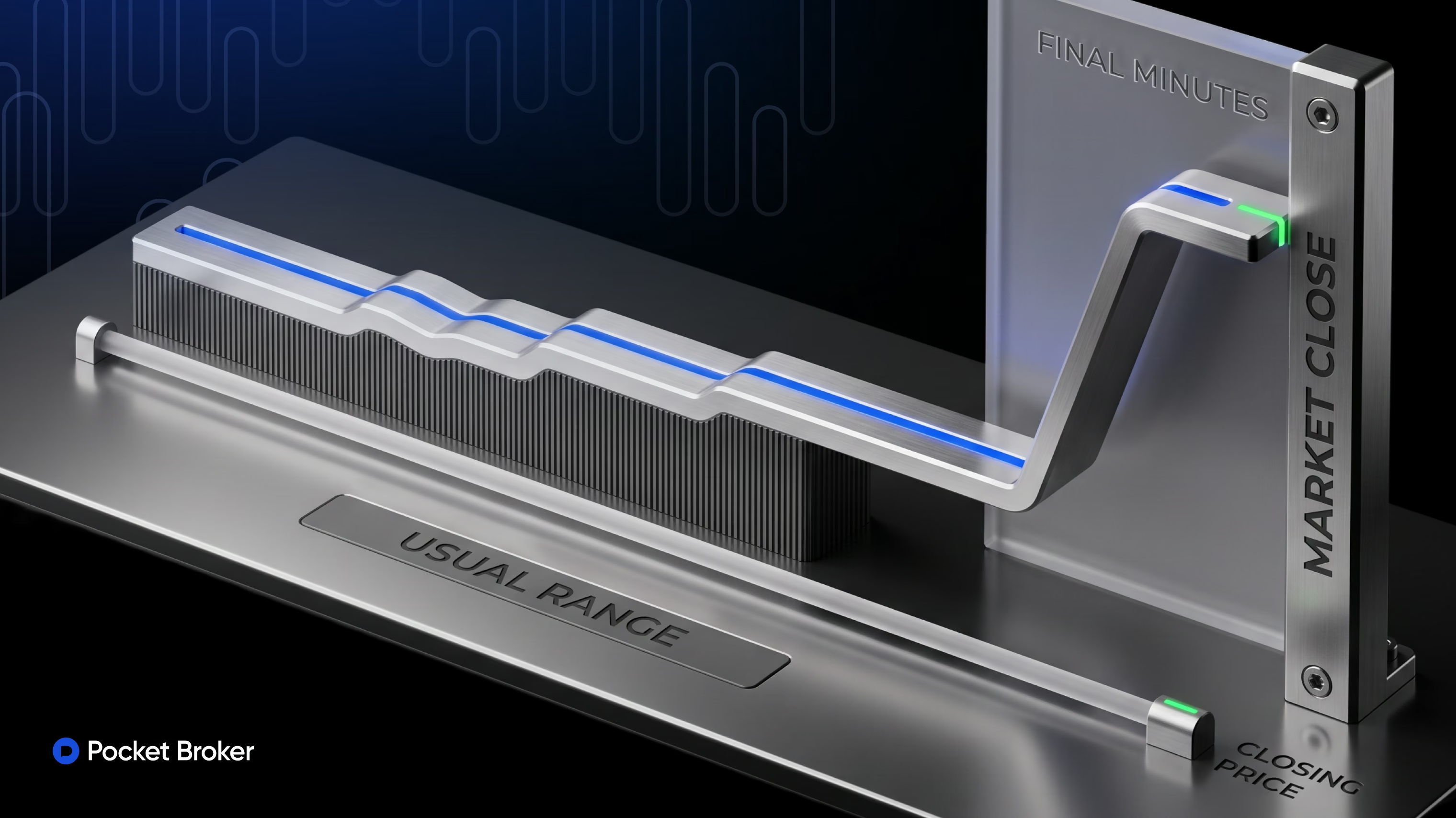
In practice, the marking the close meaning comes down to a false signal. Picture a quiet afternoon, then a burst of buying in the last minute. It can look like real demand. If it isn't, the price the market finishes on reflects that burst, not the day's honest tug-of-war between buyers and sellers.
Why the last minutes? Because there's no time left to answer. Other traders may not get a chance to correct the price before the bell, so the final print can stand as the official one. How it's done isn't the point. What it does to the price is.
Marking the Close vs Legitimate Trading at the Close
Look up any marking the close definition market manipulation guidance uses, and one word keeps coming back: intent. Same bell, same last minutes, very different motives.
Factor | Marking the Close | Legitimate Closing Activity |
|---|---|---|
Intent | Move the closing price itself | Do a normal job: rebalance, exit a position, fill an order |
Trading activity | Out of step with the instrument's usual pattern | Fits usual volume and the day's events |
Price impact | Price pushed away from where real interest would put it | Price follows real supply and demand |
Regulatory context | Can draw attention as market manipulation | Part of normal market life |
And a big volume spike or a sharp late move? That alone proves nothing. Context decides.
Why Regulators Treat It as Market Manipulation
Think of a scoreboard. If someone quietly changes the last number, everyone who reads it learns something false, even though the game itself was fair. Prices work the same way. They're supposed to come from real supply and demand. Deliberately steering one, especially a price many people lean on, breaks that link.
That's why regulators in major markets class it as market manipulation. The worry isn't one trade. It's trust: people need to believe the number in front of them was discovered, not made.
What Can Make Closing Activity Look Suspicious?
Analysts and regulators look at patterns, not single moments. These signs can call for a closer look:
A sudden change in activity just before the close
A price move with no obvious news or market event behind it
The same unusual pattern repeating over several sessions
Activity out of step with the instrument's normal volume
Any one of these alone proves nothing. Each has plenty of innocent explanations, from index rebalancing to news that broke at 3:55 p.m. Together, and with context, they might point somewhere. That judgment belongs to people with the full picture.
How Marking the Close Can Affect Other Market Participants
A distorted closing price gives a wrong picture of what a stock did that day. The chart looks different. The daily return shifts. Anyone who builds a valuation, a reference or a decision around that number is working from a skewed figure.
Does it carry into the next session? Not necessarily. Prices often reset once real trading resumes. But the closing price stays in the record for that day, and that's the one other people used.
How to Interpret Unusual Moves Near the Market Close
Say a stock trades near $50 all day, then jumps to $51.20 in the final minutes on heavy volume. Manipulation? Possibly. Or news landed at 3:55 p.m. Or a fund rebalanced. Or liquidity was thin and one large order moved a quiet book. A single price move doesn't tell you which.
Check the context first: news, liquidity, volume, what the rest of the market was doing. And don't accuse anyone of manipulating a market because of one move. Judging intent takes far more than a chart.
Risk Disclaimer: Trading involves significant risk of capital loss. This article is for educational purposes only and does not constitute financial advice. Always conduct independent research and consider your risk tolerance before making any trading decisions.
See more:Regulation & Safety