Settlement Price: What It Is and How It Is Determined
Settlement price is the official price an exchange sets to settle derivative contracts. This guide explains how it is determined, how it differs from closing and last price and what daily and final settlement mean.

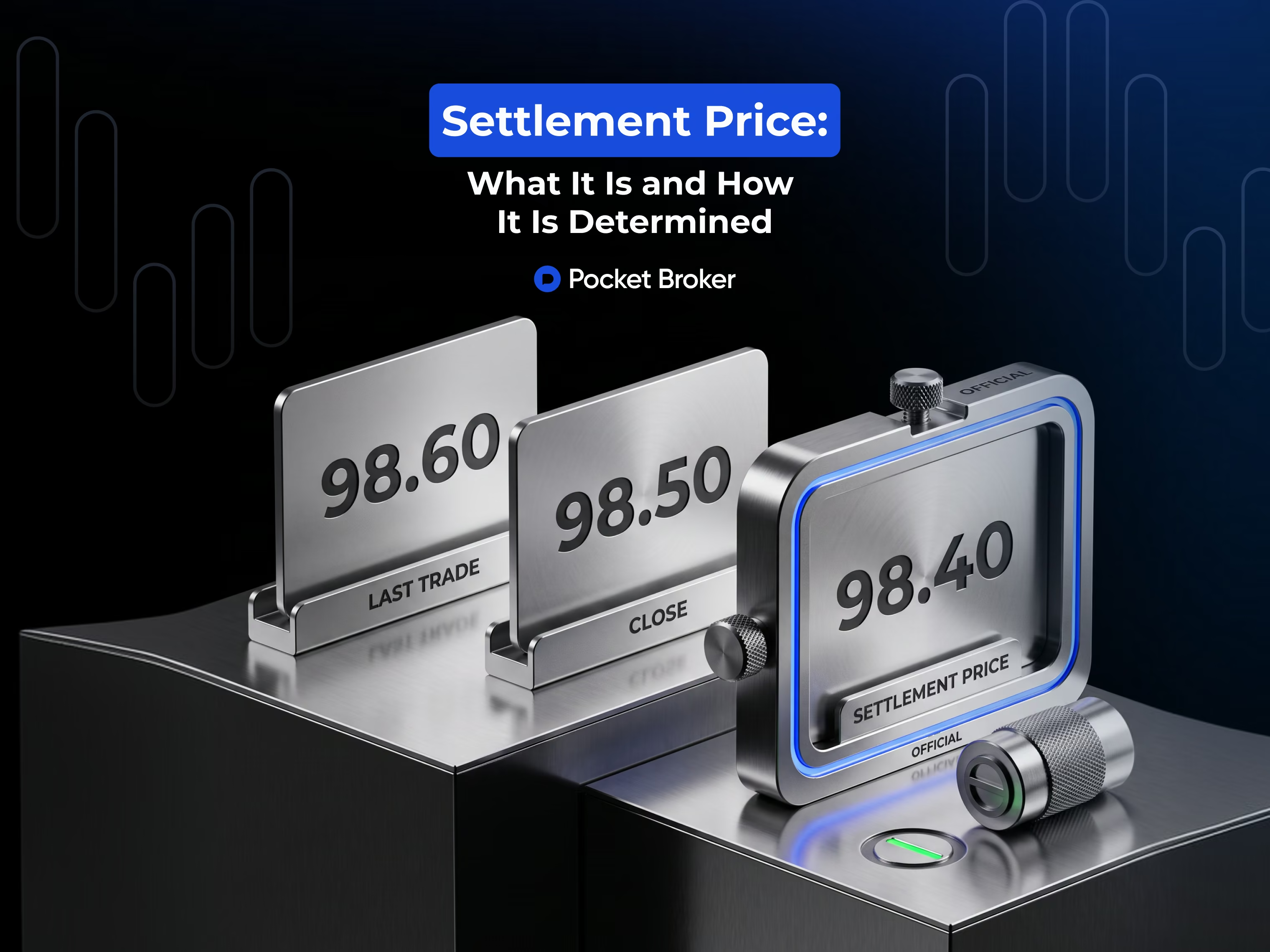
Friday, ten minutes before the bell. A futures contract trades at 98.50. One small order goes through and the last print ticks to 98.60. The session ends there. And still, the exchange publishes 98.40 as the number it will use to settle everyone's accounts that night. Weird? Not really. The last trade, the close and the official figure are three different things, and only one of them moves money.
What Is a Settlement Price?
A futures settlement price is the official price an exchange or market sets for settling derivative contracts. What it's for: daily and final settlements. Who sets it: the exchange. How: by a published method.
Does it have to match the last trade of the day? No. Sometimes it lands there. Often it doesn't, and that's on purpose.
Create an account and follow a live chart into the close to see how prices behave.
Go to Pocket BrokerA futures settlement price sounds dry on paper. Watch a market run into the close and it makes sense.
Open the chart of any liquid contract and watch the last half hour before the session ends. Trades pile up, spreads wobble, the last print jumps around. That messy stretch is exactly why exchanges don't treat one lonely trade as the final word when they set a futures settlement price. Give it one session of watching and the idea stops being abstract.
To follow a market into the close yourself, create a Pocket Broker account and open a live chart.
How Settlement Price Is Determined
Rather watch than read? You can try Pocket Broker demo and see how prices settle into the close, with virtual funds.
How is a settlement price determined? No single formula. Ingredients: actual trades, quotes, volume-weighted averages, a special settlement window, other published rules. Who picks: the exchange. Which ones: depends on the contract.
Think of a settlement price as a recipe the exchange publishes in advance. One contract might average trades over the final minutes. Another might lean on bid and ask quotes when trading is thin. A third might use a special calculation on expiry day. Same dish name, different recipes. That's why the settlement price for one contract tells you nothing about how another is built.
Settlement Price vs Closing Price vs Last Price
Three prices, three questions. Last price: where did the market trade a moment ago? Closing price: where did the session end? And the options settlement price: what's the official figure for the books? It comes from exchange rules, not from a trade you could have clicked.
Price Type | What It Represents | How It Is Used |
|---|---|---|
Last traded price | The price of the most recent trade | Shows where the market traded a moment ago |
Closing price | The price at the end of the session, as the market defines it | Used for charts and daily summaries |
Settlement price | The official price set by the exchange under its rules | Used for daily revaluation, margin and final settlement |
On a quiet day all three can land on the same number. Don't count on it. Nothing says they must.
Daily Settlement vs Final Settlement
Two kinds of settlement, two jobs. Daily settlement runs every session: the daily settlement price revalues open positions, and the gains or losses move through variation margin. Final settlement happens once, at expiration, and closes the contract out, in cash for some contracts and by delivery for others. The exact mechanics depend on the contract type and the exchange's rules.

Why Settlement Price Matters in Futures and Derivatives
Why care about the number? Because every day, the settlement price of futures contract positions feeds the accounting. Positions get marked to market. Gains and losses on open positions get credited or debited. Margin gets checked against it. At the end, final settlement closes the books.
And no, the same rules don't cover every derivative. Options, swaps and other contracts have their own.
What Can Affect a Settlement Price Calculation?
Which ingredients can go into a price settlement calculation? A handful of common ones:
Settlement time window: the minutes or period the calculation looks at
Eligible trades: only trades that meet the exchange's rules count
Trading volume: heavier trades can carry more weight in volume-weighted methods
Bid and ask data: quotes can fill gaps when few trades happen
Contract specifications: the contract's own terms shape the method
Exchange rules: the final say on every detail
That's a menu, not a checklist. Some methods use two of these. Some use others.
Why Settlement Price Can Differ From the Last Trade
Why not just use the last trade? Because the last trade can be a fluke. One small order in a thin market right before the bell, and that print says little about where the market really stood. A calculation over a wider window of trades and quotes is less sensitive to one odd trade. Think of the last trade as a snapshot and the official figure as several photos averaged together.
How to Interpret Settlement Price Carefully
One contract's rules don't carry over to the next. An index future, an energy future and an option can each settle differently, so open the official contract specifications before you assume anything. The exchange publishes its own methodology. Start there.
Risk Disclaimer: Trading involves significant risk of capital loss. This article is for educational purposes only and does not constitute financial advice. Always conduct independent research and consider your risk tolerance before making any trading decisions.
See more:Forex & Markets